What is the voltage cutoff for a Li-SOCl2 battery? The practical answer is usually near 2.0 volts under the manufacturer’s specified load. However, this value is not universal. Li-SOCl2 cells typically provide a 3.6-volt nominal output. Their terminal voltage can fall sharply during a pulse. Passivation, temperature, wiring resistance, and sensor demand all influence the reading.
IEC 60086-4 treats primary lithium batteries as application-dependent power sources. Manufacturer data sheets from Saft, Tadiran, and EVE commonly specify end-of-discharge values between 2.0 and 2.5 volts. Some low-power devices use a higher cutoff, such as 2.7 volts. That choice protects measurement accuracy and prevents unstable operation. It may also leave usable energy inside the cell. A lower cutoff can extract more capacity, but it increases voltage sag risks. It should never replace the cell maker’s tested limit.
Battery educator Isidor Buchmann explains, “Battery voltage is not constant.” That short sentence matters here. A meter may show 3.2 volts at rest, then briefly show less than 2.5 volts during a radio transmission. The cell may not be empty. The load may simply be demanding more current than the passivated anode can deliver.
Industry reports from Yole Group and IDTechEx continue to highlight reliability, energy density, and long service life as key lithium-battery design priorities. Those priorities require caution. The safest introduction is not a single number. It is a tested cutoff based on load, temperature, pulse duration, and end-device requirements. A convenient answer can still be incomplete.
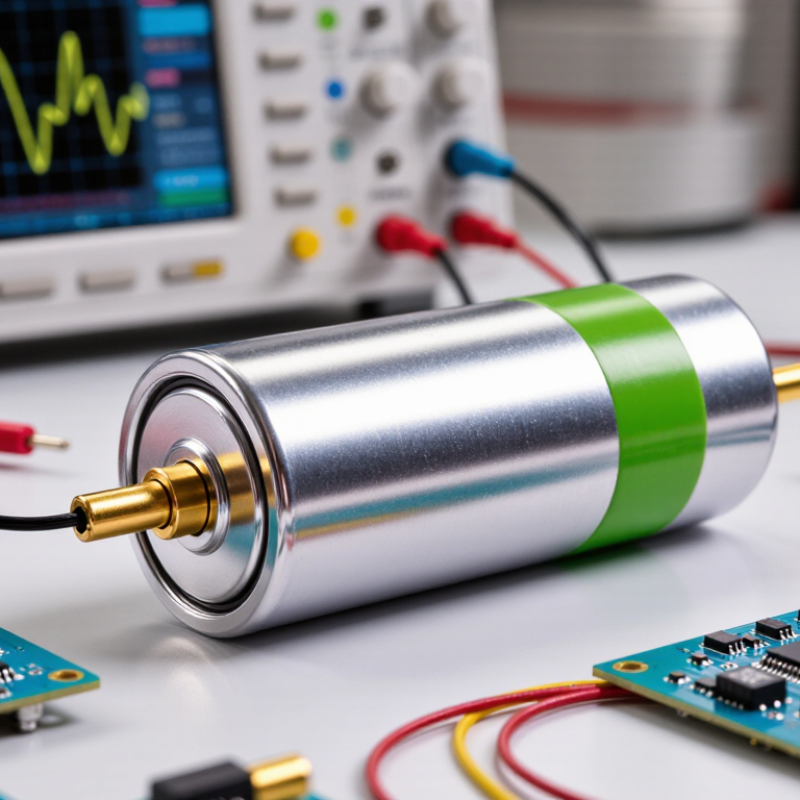
What Is the Voltage Cutoff for a Li-SOCl2 Battery?
Li-SOCl2 batteries typically provide a 3.6-volt nominal output. Open-circuit voltage often measures between 3.65 and 3.70 volts at room temperature. Their voltage remains relatively flat during discharge, commonly near 3.5 volts under light loads. This comes from the lithium–thionyl chloride electrochemical system, which offers high energy density and long shelf life. Published primary-cell datasheets commonly report operating temperatures from about -55°C to 85°C, although usable capacity changes with temperature and current.
Cutoff voltage is not universal. IEC 60086-4 defines safety and performance requirements, but it does not impose one electronic cutoff for every device. Engineering data frequently uses 2.5 to 3.0 volts as a practical load cutoff. A wireless sensor may stop near 2.7 volts, while a pulse-powered meter may reset earlier because of temporary voltage depression. The passivation layer can also create a sharp dip when current suddenly rises. That dip is not always true depletion.
Measure under the real load.
A resting cell may recover above 3.3 volts after shutdown. That can mislead technicians. High-current pulses, cold conditions, and long storage complicate diagnosis. Published battery test reports often rate capacity at low, steady currents, not repeated radio bursts. Therefore, selecting a 2.5-volt cutoff without testing the actual circuit can waste capacity or cause unstable operation. I would treat 2.7 volts as a starting point, not a final rule. Real equipment deserves real-load testing.
| Parameter | Typical Value or Range | What It Means | Practical Consideration |
|---|---|---|---|
| Cell chemistry | Lithium metal / thionyl chloride (Li-SOCl₂) | A primary, non-rechargeable electrochemical system | Do not recharge unless the cell is specifically designed and approved for rechargeable operation. |
| Nominal voltage | Approximately 3.6 V per cell | The rated operating voltage used for system design | A circuit designed for a 3.6 V Li-SOCl₂ cell should account for the full discharge-voltage range. |
| Fresh open-circuit voltage | Typically about 3.65–3.70 V | The voltage measured with no external load shortly after manufacture or installation | Open-circuit voltage is not a reliable indicator of remaining capacity because the discharge curve is relatively flat. |
| Main discharge plateau | Approximately 3.5–3.6 V under suitable loads | The relatively stable voltage region during most of the useful discharge | The actual voltage depends on current, temperature, cell size, age, and passivation. |
| Common system cutoff | Usually 2.0–2.5 V under load | The load-voltage threshold commonly used to stop operation | The correct value must come from the cell’s discharge specification and the equipment requirements. |
| Conservative cutoff for sensitive electronics | About 2.5–2.7 V under load | A higher threshold that provides additional voltage margin for regulators and controllers | This may leave some usable capacity unused but can improve system stability. |
| End-of-discharge region | Around 2.0 V or lower under load | Indicates that most usable capacity has been delivered for many applications | Continuing below the specified end voltage can cause unreliable operation and does not guarantee useful extra capacity. |
| Voltage delay after storage | Temporary voltage drop may occur | A passivation layer can form on the lithium anode during long storage or low-current operation | A brief load pulse may initially produce a lower voltage than the open-circuit reading. |
| Load effect | Higher current causes greater voltage sag | Internal resistance and electrochemical polarization reduce the terminal voltage during pulses | Set the cutoff using the worst-case operating current, not only the no-load voltage. |
| Series connection | Voltage adds approximately linearly | Two cells provide about 7.2 V nominal; three cells provide about 10.8 V nominal | Multiply the selected per-cell cutoff by the number of series cells, while considering imbalance. |
| Recommended design rule | Use the manufacturer-specified end voltage; 2.0–2.5 V per cell is a common design range | There is no universal cutoff for every Li-SOCl₂ cell or application | Validate the threshold with the cell’s discharge curves, pulse-load requirements, temperature range, and regulator minimum-input voltage. |
A practical cutoff often ranges from 2.0 to 2.5 volts under load. No single value fits every device.
Its nominal voltage is about 3.6 volts. A new cell may measure near 3.65 volts without a load.
Internal resistance creates voltage sag when current rises. A wireless transmission may briefly pull the terminal voltage below 2.0 volts.
Yes. Measure directly across the battery terminals during the real operating load. A resting reading can look healthy but mislead you.
Cold temperatures increase internal resistance. Near freezing, a sensor may trigger a false low-voltage alarm.
It can. One device may stop too early, while another may need that protection. The simple rule deserves review.
A capacitor or pulse-support circuit can reduce short voltage drops. Test the highest expected transmission demand.
Use an undervoltage monitor or load switch with hysteresis. Otherwise, the device may restart repeatedly around the threshold.
Test the complete system at cold and warm temperatures. Include the highest pulse current and measure voltage during operation.
Yes. Age and storage conditions can change performance. I would not trust a cutoff chosen from a spreadsheet alone.
Understanding what is the voltage cutoff for a li-socl2 battery requires more than choosing a single fixed value. Lithium thionyl chloride batteries typically provide a nominal voltage of about 3.6 volts, with their operating voltage gradually decreasing as energy is used. The practical cutoff may commonly fall around 2.5–3.0 volts under load, but the correct threshold depends on the device, current demand, pulse requirements, temperature, and the battery’s internal resistance. Since these batteries are generally primary, non-rechargeable cells, the cutoff should be treated as the minimum safe operating voltage rather than a recharge point.
To apply the cutoff correctly, measure the battery both at rest and while the device is operating, because voltage can temporarily drop during high-current pulses. A monitoring circuit should account for this temporary sag and avoid shutting down unnecessarily, while still preventing unstable operation or data loss. Always follow the cell manufacturer’s technical specifications, use suitable protection electronics, and test the cutoff under realistic load and temperature conditions.

 Nuwon Energy