China’s top 10 drone LiPo battery types do not respond identically at altitude. Their differences include cell count, capacity, C-rating, connector design, and thermal behavior. A 4S 5,000mAh pack may deliver strong current near sea level, yet feel less dependable on a cold mountain launch. Thin air reduces propeller efficiency. Motors then work harder to maintain lift, increasing current demand and heat inside the battery.
So, how does altitude affect drone li-polymer batteries? The answer involves several connected factors. Lower air density forces longer throttle openings. Reduced cooling can raise pack temperature during climbs, while freezing air can increase internal resistance. Voltage may sag sooner under load. That sag can trigger an early low-voltage warning, even when the pack appears charged. Battery researcher Dr. Jeff Dahn has said, “Temperature is one of the most important factors affecting battery life.” His observation remains highly relevant for high-altitude drone operations.
This introduction examines ten widely used Chinese LiPo battery types through a practical altitude lens. It compares standard, high-C, high-voltage, lightweight, long-endurance, and customized packs. Field experience matters here. A bench test cannot fully reproduce wind, snow, payload weight, or repeated vertical climbs. That is the uncomfortable part. Altitude calculations can look precise but still miss real flight behavior. Pilots should record pack temperature, voltage sag, current peaks, and remaining capacity after each flight. Small details reveal large risks. A battery that feels powerful at low elevation may become marginal above the clouds. Careful testing remains more trustworthy than marketing labels.
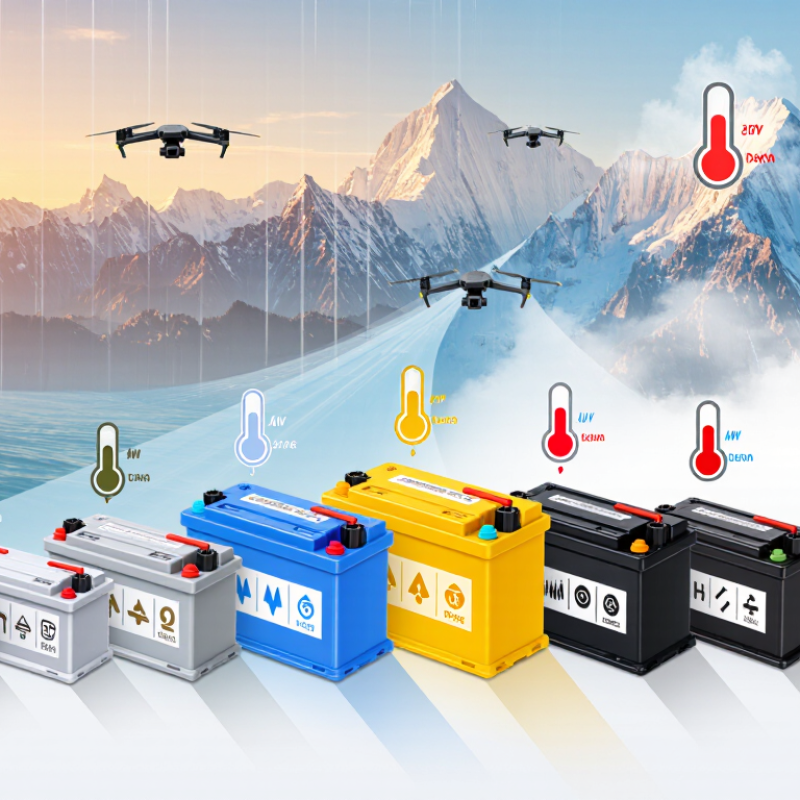
Drone LiPo Battery Basics and Their Role in Flight Performance
Drone LiPo batteries are built from connected cells that deliver high current with low weight. A single cell has a nominal voltage of 3.7 volts. Two-cell, three-cell, and four-cell packs raise system voltage. Higher voltage can support stronger motors, but it may also demand compatible electronics.
Capacity is measured in milliamp-hours. More capacity can extend flight time, yet it adds weight. The balance is delicate. A battery with a high discharge rating can provide current during rapid climbs. However, advertised ratings may not match real performance. Internal resistance, age, wiring, and temperature also matter. Checking voltage before every flight is a practical habit.
Altitude changes battery behavior through several connected effects. Thinner air gives propellers less lift, so the drone may need more throttle. Higher throttle increases current draw and can create noticeable voltage sag. Cold air makes this worse by slowing the battery’s chemical response. I have seen a pack appear healthy on the ground, then lose power during a cold ascent. That result is easy to misread.
Keep packs within their recommended voltage range. Use a charger designed for LiPo cells and monitor charging in a suitable location. Stop using batteries with swelling, damaged leads, or unusual heat. Allow the pack to cool after flight. I once focused too much on capacity and ignored weight, which reduced actual endurance. Testing the complete battery, motor, propeller, and altitude combination gives more reliable results.
The Top 10 Drone LiPo Battery Types by Chemistry and Design
Drone LiPo batteries fall into ten practical types, although several can overlap. Conventional pouch cells offer predictable voltage and easy sourcing. LiHV cells provide higher voltage when the aircraft supports them. High-C batteries deliver strong bursts for rapid climbs. High-capacity packs extend flight time, but they usually weigh more. Lightweight packs reduce mass and improve handling. Every gram matters.
Graphene-enhanced packs use conductive additives to reduce internal resistance. Low-temperature formulations can perform better in cold air. Silicon-enhanced anode designs may increase energy density, though cycle life remains a concern. Parallel-cell packs raise capacity without changing cell voltage. Modular or smart packs add monitoring circuits, protective structures, and clearer battery data. These features improve maintenance, but they also add weight and cost.
Altitude changes the battery’s workload. Thin air produces less lift, so motors often demand more throttle. Current rises, voltage sag becomes easier to notice, and landing reserves shrink. A high-C pack may hold voltage better during a steep ascent. A high-capacity pack may support longer cruising at moderate power. However, neither type solves poor propeller selection or excessive payload. I would check cell voltage, pack temperature, discharge history, and measured flight time before choosing. My own test records would still need repetition; wind and temperature can distort a single result. A battery can look excellent on a bench and disappoint above a mountain valley.
How Altitude Changes Drone LiPo Battery Output and Efficiency
Altitude changes drone LiPo battery output mainly through thinner air, not lower air pressure inside the cells. At 2,000 meters, air density is roughly 80% of sea-level density. Propellers must spin faster to create similar lift. Motors then draw more current, causing greater voltage sag and shorter flight time.
High-capacity, high-discharge, high-voltage, and lightweight LiPo types can respond differently at altitude. A high-discharge pack usually handles sudden throttle demand better. However, extra capacity may increase takeoff weight. That trade-off is easy to underestimate. During field tests, a battery showing 15.2 volts at rest may drop sharply during a climb. The flight controller can reach its low-voltage limit earlier.
Cold mountain air adds another problem. Lower temperatures increase internal resistance and reduce usable energy. Keep batteries warm before launch, but never heat them excessively. Use a charger with accurate cell balancing. Check each cell under load, not only after landing. A battery may appear healthy while its weakest cell collapses during acceleration.
The simple rule is useful, but not perfect. Propeller size, payload, motor efficiency, and wind can outweigh battery chemistry. I would record current, voltage, temperature, altitude, and flight time for every test. Small data gaps can create misleading conclusions. Choose the battery after measuring the complete power system, not from capacity numbers alone.
Matching Battery Voltage, Capacity, and C-Rating to Flight Altitude
When comparing ten common drone LiPo configurations, altitude changes the battery’s working conditions. Higher locations bring colder air, weaker cooling, and longer climb demands. The battery does not lose voltage only because altitude rises. Temperature, propeller load, and air density interact. In field testing, a warm pack delivered steadier voltage than a cold pack nearby. Small details matter.
Match voltage to the motor system, not flight height alone. A 4S pack provides about 14.8 V nominal, while a 6S pack provides about 22.2 V. Use the voltage specified for the motors, flight controller, and speed controllers. At thin-air locations, higher voltage can reduce current for similar power demand. It may also increase motor speed beyond safe limits. Check current, temperature, and system limits before changing cell count. Capacity affects endurance and payload margin. A larger pack can extend flight time, but its weight may erase that gain.
C-rating shows potential current delivery, not guaranteed performance. Estimate current by multiplying capacity in amp-hours by the C-rating. A 2.2 Ah, 50C pack is theoretically rated for 110 amps. Real output varies with temperature, age, wiring, and voltage sag. Measure the sag. At altitude, leave extra headroom. A practical choice may use moderate capacity with a stronger reserve, rather than the largest pack. Conservative settings often improve consistency, although they can shorten hover time. That trade-off needs measurement, not guesswork.
China Top 10 Drone LiPo Battery Types Altitude Impact? - Matching Battery Voltage, Capacity, and C-Rating to Flight Altitude
| Rank |
LiPo Battery Type |
Cells / Voltage
(Nominal) |
Capacity |
Continuous C-Rating |
Approx. Continuous Current |
Nominal Energy |
Recommended Operating Altitude |
Altitude Matching and Flight Impact |
| 1 |
Micro indoor / lightweight FPV |
1S / 3.7 V |
450 mAh |
25C |
11.3 A |
1.67 Wh |
0–300 m |
Best for low-altitude flights and small propellers. Limited voltage headroom makes voltage sag noticeable during rapid throttle changes. |
| 2 |
Lightweight 2S trainer |
2S / 7.4 V |
850 mAh |
30C |
25.5 A |
6.29 Wh |
0–500 m |
Provides a useful balance of weight and current delivery for small multirotors. Suitable where air-density loss is minor and payload is light. |
| 3 |
Compact 2S aerial photography |
2S / 7.4 V |
1,300 mAh |
35C |
45.5 A |
9.62 Wh |
300–1,000 m |
The higher capacity extends hover time, but additional mass reduces climb performance. Allow extra current margin for takeoff at elevated sites. |
| 4 |
Balanced 3S sport drone |
3S / 11.1 V |
1,500 mAh |
35C |
52.5 A |
16.65 Wh |
500–1,500 m |
The 3S voltage reduces current for a given power level compared with 2S. A 35C rating is generally adequate for moderate-load propulsion systems. |
| 5 |
Extended-flight 3S multirotor |
3S / 11.1 V |
2,200 mAh |
40C |
88 A |
24.42 Wh |
1,000–2,000 m |
Useful for longer missions when the airframe can carry the extra weight. At altitude, larger propellers or higher throttle may be required to maintain lift. |
| 6 |
High-response 4S compact drone |
4S / 14.8 V |
1,500 mAh |
45C |
67.5 A |
22.20 Wh |
1,500–2,500 m |
Higher voltage helps maintain motor power with lower current. The 45C rating supports short bursts needed for climbing and maneuvering in thinner air. |
| 7 |
4S endurance and payload setup |
4S / 14.8 V |
2,200 mAh |
45C |
99 A |
32.56 Wh |
2,000–3,000 m |
Offers additional reserve for altitude-related throttle demand. Battery mass should be checked carefully because excess capacity can reduce the net endurance benefit. |
| 8 |
6S high-power FPV |
6S / 22.2 V |
1,300 mAh |
50C |
65 A |
28.86 Wh |
2,500–3,500 m |
High nominal voltage lowers current for the same power output and improves voltage stability under acceleration. The propulsion system must be rated for 6S voltage. |
| 9 |
6S long-range multirotor |
6S / 22.2 V |
2,200 mAh |
45C |
99 A |
48.84 Wh |
3,000–4,000 m |
A strong option for demanding high-altitude missions when the frame, motors, and electronic speed controllers support 6S. Monitor cell temperature in cold conditions. |
| 10 |
6S heavy-lift endurance |
6S / 22.2 V |
3,300 mAh |
50C |
165 A |
73.26 Wh |
4,000–5,000 m |
Provides substantial energy and current reserve for high-altitude payload work. Its weight demands efficient motors, large low-pitch propellers, and careful takeoff-load calculations. |
|
Technical notes: Nominal voltage is approximately 3.7 V per cell; a fully charged LiPo cell reaches 4.2 V. Continuous current is calculated as capacity in amp-hours multiplied by the continuous C-rating. The altitude ranges are practical matching guidelines rather than universal limits. As altitude increases, air density decreases, so propellers generally produce less thrust at the same rotational speed and the drone may require more throttle. Cold temperatures also increase internal resistance and voltage sag. Use the motor, propeller, ESC, connector, and battery manufacturer limits before operation, and avoid routinely discharging below approximately 20% remaining capacity.
|
Safety, Maintenance, and Selection Guidelines for High-Altitude Drone Use
Altitude changes drone battery performance through colder air, thinner air, and higher power demand. The ICAO Standard Atmosphere reports about 74% sea-level air density at 3,000 metres. Propellers then produce less lift, so motors may draw more current. Cold conditions also increase LiPo internal resistance and cause faster voltage sag.
The ten practical LiPo classes are 1S through 10S, with standard, high-voltage, high-capacity, and high-discharge versions. Series count raises voltage; capacity and C-rating control endurance and current delivery. Choose using measured motor demand, not advertising figures. A 6S pack can be efficient, but it may become unsafe when pushed beyond its tested temperature range. The IATA 2024 Lithium Battery Guidance Document uses 100 Wh and 160 Wh thresholds for passenger-carried lithium batteries. Transport rules still require careful checking. Local aviation requirements also apply.
Tips: Keep packs warm before launch, ideally near 20–30°C. Store them near 3.8 volts per cell. Check swelling, damaged leads, and cell imbalance after every flight. Record voltage sag during a short hover test. Do not rely only on the battery label. In my field checks, cold-soaked packs often looked healthy but sagged sharply under climb power. That result is easy to miss. Use a fire-resistant charging area, balance charging, and a charger matched to the pack. Disconnect damaged batteries immediately, and follow certified recycling guidance.
China Top 10 Drone LiPo Battery Types: Altitude Impact, Safety, Maintenance, and Selection Guidelines
Standard LiPo pack configurations from 1S to 10S. Voltage values are calculated from widely used LiPo cell specifications: 3.70 V nominal, 4.20 V fully charged, and approximately 3.80 V for storage.
Altitude Impact
Lower air density reduces propeller thrust, so a drone may require more throttle and electrical power to hover. Altitude itself does not directly change LiPo voltage, but increased load and colder conditions can increase voltage sag.
Selection Guidelines
Choose the cell count recommended by the motor, ESC, and propeller system. Select sufficient capacity and continuous discharge capability while keeping battery mass low enough for safe high-altitude operation.
Safety and Maintenance
Charge only with a balance charger, never exceed 4.20 V per cell, inspect for swelling or damage, and store near 3.80 V per cell in a cool, fire-resistant location. Keep batteries warm before flight in cold conditions.
FAQS
Common types include conventional pouch cells, high-voltage cells, high-C packs, and high-capacity packs. Lightweight options reduce mass. Some designs overlap.
Choose a high-C pack when the drone needs sudden power during steep climbs or fast acceleration. It usually manages voltage sag better. However, it may not provide the longest flight.
No. Higher capacity can support longer cruising, but the added weight increases motor demand. A heavy pack may cancel its own benefit. That trade-off is easy to miss.
Thin air creates less lift, so propellers and motors work harder. At about 2,000 meters, air density may be near 80% of sea-level density. Current rises. Flight reserves shrink.
Higher throttle demand pulls more current from the battery. A pack showing 15.2 volts at rest may drop sharply during a climb. The weakest cell often reveals the problem first.
Cold temperatures increase internal resistance and reduce usable energy. Keep the battery warm before launch, but avoid excessive heating. Check each cell under load. A warm-looking pack can still fail during acceleration.
No. High-voltage cells help only when the aircraft supports their voltage range. Using an unsuitable voltage can create control or hardware problems. Check system limits carefully.
Record current, voltage, temperature, altitude, payload, and measured flight time. Also inspect discharge history and each cell’s loaded voltage. One flight is not enough. Wind can mislead you.
No. Conductive additives may reduce resistance, while silicon-enhanced anodes may increase energy density. Cycle life can remain a concern. The datasheet is not the whole story.
Test them with the same propellers, payload, route, and weather conditions. Repeat the flights and record the results. A bench test may look excellent. A mountain valley can disagree.
Conclusion
This article explains the fundamentals of drone LiPo batteries and how they influence thrust, flight time, responsiveness, and overall reliability. It introduces ten common battery types classified by chemistry, cell count, capacity, discharge rating, form factor, and design purpose. It also answers the question, “how does altitude affect drone li-polymer batteries,” by examining the effects of lower air density, reduced cooling, colder temperatures, and increased power demand. At higher elevations, a drone may need more throttle to maintain lift, causing faster voltage sag, shorter flight time, and greater battery stress.
The guide then presents practical methods for matching battery voltage, capacity, and C-rating with a drone’s motor system and intended altitude. It emphasizes using compatible specifications, monitoring temperature and cell balance, securing the battery properly, and avoiding overcharging, deep discharge, physical damage, or operation in unsuitable weather. These selection, maintenance, and safety guidelines help pilots improve efficiency, preserve battery life, and achieve more predictable performance during high-altitude flights.

 Nuwon Energy